
Douglas County Scheduled and Actual Release
A projected or scheduled date is a calculation based on the sentence, applicable minimum term, credited custody, conditional-release structure, and later case events. It is not proof that a person left a jail or prison. Actual release occurs only after the holding agency processes the event and resolves court orders, holds, and release conditions. A transfer to MODOC or another authority is also an exit from Douglas County Jail, but it is not a return to the community.
Pretrial detention works differently. A person held before final disposition has no sentence-based projected release date. Release may turn on bond, dismissal, a court order, or transfer. Case.net can show the legal event, while the Douglas County Sheriff can confirm whether the person physically left and whether the outcome was release or transfer.
A sentenced state prisoner may leave the institution on parole or conditional release and still remain in DOC legal custody. Final discharge comes later. The phrase “release date” must therefore be paired with the specific event being measured.
Find a Douglas County Projected Release Date
Begin by deciding whether the person is in Douglas County Jail, a Missouri prison, or another authority’s custody. The systems are not interchangeable. The county jail handles local custody and county-sentence calculations. The Missouri Department of Corrections handles state prison sentences and field supervision. A live roster confirms current custody, not a past release.
- Identify the current holding agency through the jail, court case, or active MODOC record.
- For a state prisoner, search the MODOC Offender Search manually by legal name, alias, or DOC number.
- Review all active sentence information and any assigned place. Do not treat one completed sentence row as the whole case.
- For a county-jail sentence, obtain the judgment, certified jail credit, and jail calculation from the Circuit Clerk and Douglas County Sheriff.
- Ask the holding agency whether a detainer, consecutive sentence, Board action, or amended court order affects the expected date.
- Confirm the actual event after the date passes, including whether it was community release, supervision, or transfer.
The active MODOC search does not show fully discharged offenders. Its absence cannot prove that no past state custody existed. MODOC’s Sunshine data covers people who are or have been supervised and updates nightly, but it is a coded dataset rather than a simple profile. A historical question may require a focused records request and a review of all rows for the DOC number.
For the county path, the Douglas County release and records overview explains how the sheriff release sheet and court disposition complement each other. One shows physical processing; the other shows the legal order.
Douglas County MODOC Release Fields
MODOC’s data dictionary does not use one universal “projected release date” label. It names two sentence fields: Sentence-I Minimum Release Date and Sentence Maximum Release Date. The first is a calculated minimum date on an active sentence. The second is the maximum release or expiration date for that sentence. These fields should not be merged or described as a guaranteed exit day.
| Official term | What it describes | Main limit |
|---|---|---|
| Sentence-I Minimum Release Date | Calculated minimum date for an active sentence | Other sentences, holds, or Board action may still control. |
| Sentence Maximum Release Date | Maximum release or sentence-expiration date for that sentence | It is sentence-specific and may not describe the next custody event. |
| Presumptive parole release date | A tentative Board-related release date | It depends on suitable conduct and an acceptable release plan. |
| Completed Flag | That particular sentence row is complete | Another sentence, transfer, or supervision status may remain active. |
The official active offender search image shows the state source used for Douglas County prisoners who remain under MODOC authority.
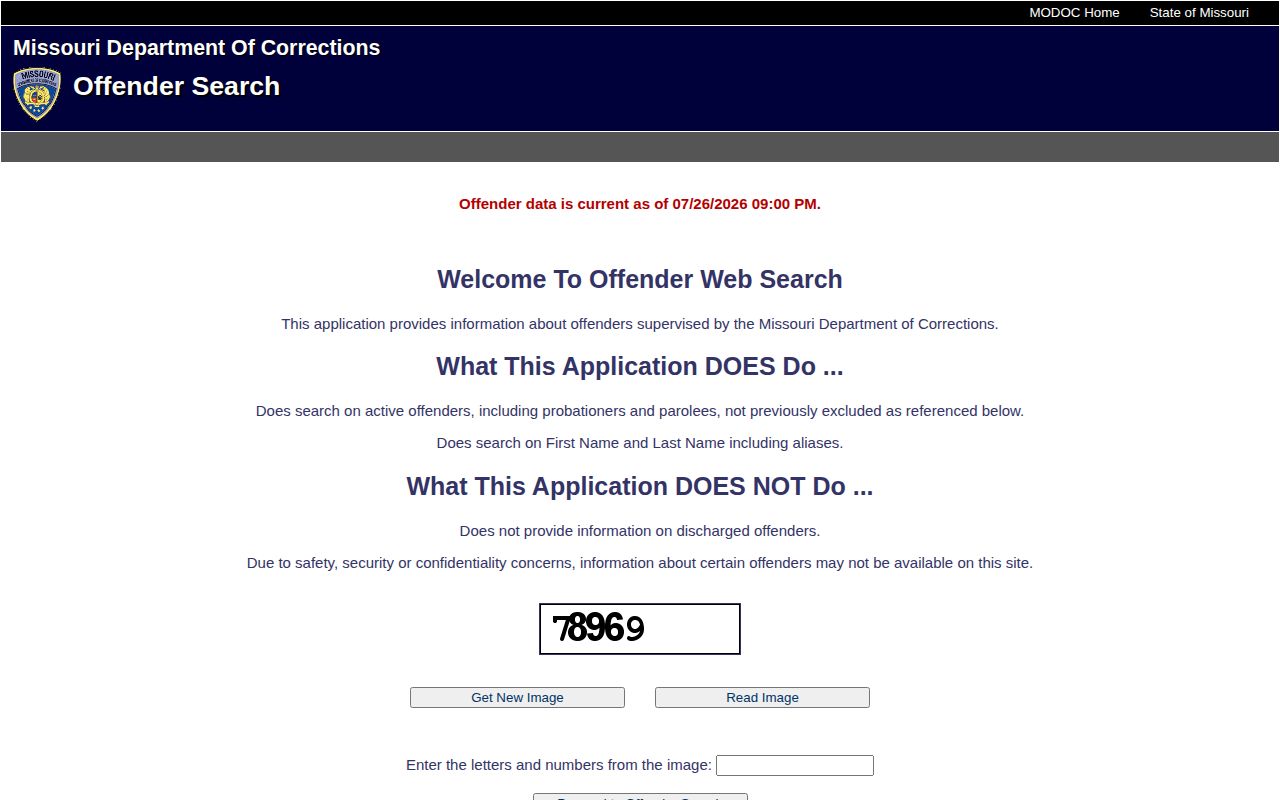
Search manually and save the date checked because the portal time-stamps its data currency.
When the search is unclear, contact the assigned institution caseworker or Probation and Parole field officer. MODOC Constituent Services can help route a precise status question. Provide the full name, DOC number, and date of birth when available.
Douglas County Conditional Release Calculation
Missouri §558.011 divides many qualifying term-of-years felony sentences into an incarceration term and a conditional-release term. For sentences of nine years or less, the conditional-release part is generally one-third. For more than nine through fifteen years, it is three years. For more than fifteen years, it is five years. The prison term is the remainder. Specified categories, including dangerous felonies and some repeat remands, are excluded from that ordinary structure.
Conditional release means supervision in the community. It is not final discharge, and it is not the same as a county-jail good-time reduction. Following statutory procedure, the Board can extend the conditional-release date up to the whole sentence for institutional rule violations. Program requirements and Board decisions may also affect a presumptive date.
Pre-sentence custody credit is another part of the calculation. Missouri §558.031 addresses qualifying custody credit based on sheriff certification. That credit can change the apparent release calculation. The actual certified amount should come from the case and agency record, not an informal count of calendar days.
Note: Conditional release begins supervision; it does not mean the Douglas County person has reached final DOC discharge.
Douglas County Limited 85 Percent Rule
Missouri does not impose an 85 percent rule on every prisoner. Missouri §558.019 sets minimum prison terms for specified cases. Its dangerous-felony provision requires 85 percent or until age seventy after serving at least 40 percent, whichever occurs first. Other parts of the statute use 40, 50, or 80 percent for covered non-dangerous offenses based on prior DOC commitments, with offense and date limits.
No reliable Douglas County projected release date can be calculated from sentence length alone. The record must account for the offense, sentence date, dangerous-felony status, prior commitments, consecutive structure, custody credit, statutory exclusions, and later institutional or Board action. A broad statement that all Missouri prisoners serve 85 percent is false.
Parole eligibility also involves Missouri §217.690 and case-specific rules. A parole hearing does not guarantee release. The Board may set a future presumptive date, deny release and schedule reconsideration, or take another authorized action. The Board considers institutional adjustment, program work, risk and needs, and release readiness. A future date remains tentative until the prison processes the release.
Changes to Douglas County Release Dates
A calculated date can move because the underlying legal or custody facts change. Some events affect eligibility. Others affect whether the person can leave the current institution on that date. The agency record should identify which factor applies.
| Factor | Possible effect | Where to verify |
|---|---|---|
| Institutional violation | May extend conditional release or affect a tentative Board date | Institutional caseworker or MODOC record |
| Detainer or hold | May cause transfer to another authority instead of community release | Holding agency and requesting authority |
| Amended court order | May change the controlling sentence or custody terms | Case.net and certified Circuit Clerk record |
| Consecutive sentences | May change parole eligibility and the controlling maximum date | Judgments, all MODOC sentence rows, and §217.690 analysis |
| Parole Board action | May set, defer, deny, or reconsider a presumptive release | Board notice and MODOC case contact |
| Certified jail credit | May alter the sentence calculation | Sheriff certification, judgment, and MODOC calculation |
A detainer is a request or hold from another authority. It can mean that a person exits one facility only to enter another agency’s custody. The Douglas County jail release record should be checked for destination and release type. Roster disappearance alone does not distinguish release from transfer.
Douglas County Jail Has No Published Formula
No researched Douglas County source publishes a local jail good-time formula. The Missouri prison conditional-release fractions should not be applied to a Douglas County Jail term. No source also established a county weekend-release adjustment. The proper local calculation comes from the judgment, certified jail credit, and the sheriff’s release calculation.
This Douglas-specific gap matters. An online calculator may assume state-prison rules, ignore partial days, miss an amended judgment, or fail to account for another hold. Call the Douglas County Sheriff at 417-683-1020 for the jail calculation and physical status. The Circuit Clerk at 417-683-4713 can supply the judgment and docket. The offices answer separate parts of the question.
For a person awaiting trial, ask about bond and the current court order rather than good time. For a sentenced county inmate, ask which jail credits the agency certified. For a transfer to MODOC, switch to the state sentence record. These paths prevent a local jail date from being confused with a state prison date.
Note: Douglas County publishes no verified local good-time equation, so obtain the calculation from the sheriff and controlling court record.
Douglas County Post-Release Credit
Earned compliance credit under Missouri §217.703 applies after release to eligible people on community supervision. It provides credit for each full compliant calendar month in qualifying cases, subject to exclusions, conditions, restitution requirements, and the statute’s required time served. It shortens the remaining supervision term toward final discharge.
That credit is not prison good time. It does not move the day a person left prison, and it should not be used to calculate a county-jail release. A Douglas County person may have a prison release date, a later parole or conditional-release supervision period, and a still later final discharge date. Each event belongs to a different record.
The active MODOC search may continue to show a released person while parole, probation, or conditional release remains active. Once final discharge occurs, the person drops from that active search. Historical verification then depends on DOC’s retained records or Sunshine data.
Confirm a Douglas County Release Date
Use the source closest to the event. The Douglas County Sheriff confirms local jail custody, physical release, and transfer. The Circuit Clerk confirms the court order and sentence. MODOC confirms state sentence fields, institutional status, parole action, and field supervision. Comparing all three prevents one system’s date from being given a meaning it does not carry.
MOVANS can supply a timely custody-change alert, but it is not a certified release sheet. Missouri now uses the current MOVANS portal for local-jail SMS and email notices. A failed local-jail search can mean the jail is offline, so a blank result is not proof of release. The VINELink Inmate Search page describes Douglas County’s current MOVANS route and its limits.
After a projected date passes, verify the destination and release type. Community release, parole, conditional release, transfer, and final discharge are separate outcomes. Keep the date each source was checked. If records conflict, ask the office that owns the disputed field to explain or correct it rather than choosing the most convenient date.